10 Best AI Detectors in 2026: Compared for Accuracy
AI detectors can help you assess whether text is likely to have been generated or assisted by an AI system, but choosing one is harder than comparing a few percentage scores.
A detector can perform well on one type of writing and poorly on another. Results can also change with text length, the AI model that generated the text, editing, paraphrasing, language, and the threshold used by the detector. That means the “best AI detector” is not necessarily the tool with the biggest accuracy claim. It is the tool that fits your purpose while giving you enough context to interpret its result responsibly.
This guide compares 10 widely used AI detectors by use case, features, accessibility, and the quality of evidence behind their claims. No detector should be treated as proof of authorship on its own.
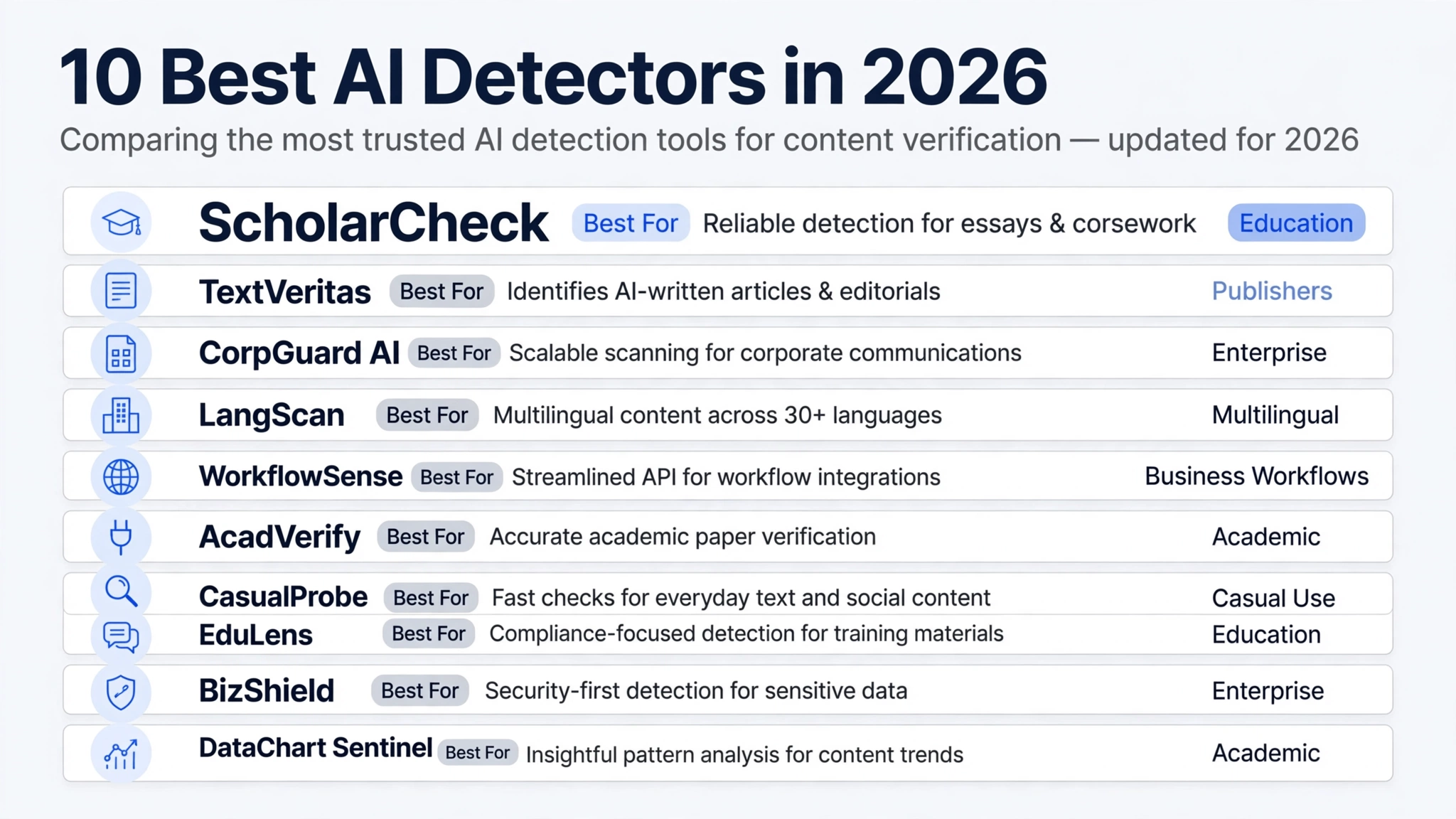
Best AI Detectors at a Glance
| AI Detector | Best for | Main strength | Important caution |
|---|---|---|---|
| Pangram | Publishers, organizations, advanced workflows | AI and AI-assisted text classification, API workflows | Product claims should be separated from independent evidence |
| GPTZero | Educators and accessible checking | Broad model coverage and passage-level analysis | A detector score is still a statistical prediction |
| Originality.ai | Publishers and content teams | AI detection plus plagiarism/content workflows | Short text and edited writing can affect results |
| Copyleaks | Multilingual and enterprise use | 30+ language support, APIs and integrations | Vendor accuracy claims are not universal benchmarks |
| Turnitin | Schools and universities | Institutional academic-integrity workflow | Access is generally institution-focused |
| Winston AI | Media and content workflows | Detection combined with broader content-analysis features | Results still need human review |
| Quetext | Combined plagiarism + AI checks | Two useful checks in one workflow | Do not treat either score as conclusive authorship evidence |
| Sapling | Business and team workflows | Fits inside professional writing workflows | Better suited to workflow screening than high-stakes judgment |
| Scribbr | Simple academic self-checking | Easy access for individual users | Free access does not eliminate false-positive risk |
| ZeroGPT | Casual first-pass checking | Simple interface and broad accessibility | Best used as an initial signal, not a final verdict |
The table is a practical editorial comparison, not a claim that one detector is universally more accurate than every other detector.
1. Pangram — Best for Advanced Detection Workflows
Pangram focuses specifically on AI-content detection and offers AI and AI-assisted classification, including API access for organizations that need to incorporate detection into a larger workflow. Its current API documentation distinguishes outputs such as AI-generated, AI-assisted, and human-written content. (Pangram)
That makes Pangram particularly interesting for publishers, moderation teams, and organizations that need more than a simple percentage score.
One reason to evaluate it carefully is its emphasis on false positives and model identification. Pangram also publishes its own comparison research, but readers should distinguish vendor-led testing from independent evaluations before treating any ranking as definitive.
Best for: publishers, platforms, moderation teams, and organizations building detection into software.
2. GPTZero — Best for Educators and Accessible Checking
GPTZero is one of the most recognizable AI detectors and supports text from multiple major language models. Its current detector can identify likely AI-generated passages and provide more granular feedback than a single document-level result. (GPTZero)
GPTZero also offers browser and document-oriented workflows, making it accessible to teachers, students, writers, and other individual users.
The main limitation is the same one that applies to every detector: a high AI probability is not the same thing as proof that a person used AI. The result should be considered alongside the writing itself, the assignment requirements, drafts, revision history, or other available evidence.
Best for: educators, individual writers, and users who want an accessible detector with detailed results.
3. Originality.ai — Best for Publishers and Content Teams
Originality.ai is designed around content verification and combines AI detection with related publishing workflows. Its current platform includes plagiarism checking, integrations, API access, and detection across multiple languages. It also provides limited free AI scans for individuals who want to try the detector. (Originality.ai)
For publishers and SEO teams, the biggest advantage is workflow depth rather than simply receiving an AI percentage. Teams can use detection as one part of a broader editorial quality process.
Originality.ai also warns that shorter text can affect accuracy and notes that some AI-based editing or rewriting tools may create false positives. (Originality.ai)
Best for: publishers, agencies, editorial teams, and content-quality workflows.
4. Copyleaks — Best for Multilingual and Enterprise Use
Copyleaks combines AI detection with plagiarism checking and supports more than 30 languages according to its current product documentation. It also offers API and learning-management-system integrations. (Copyleaks)
That makes it a strong option when detection needs to operate across multiple languages or inside a larger educational or enterprise system.
Copyleaks publishes strong accuracy claims, but those figures should be understood as vendor-reported performance rather than a universal score that applies to every document and language. Independent research continues to show that detector performance varies by dataset and testing conditions.
Best for: multilingual teams, schools, enterprises, and organizations needing integrations.
5. Turnitin — Best for Academic Institutions
Turnitin is different from most consumer AI detectors because its AI writing detection is built into an academic-integrity ecosystem. Its current documentation says the AI writing report is designed to help instructors identify text that may have been generated or modified by AI, while also warning that the model can misidentify human and AI-written content. (Turnitin)
Turnitin's current guidance is especially important for students and teachers: an AI detection result should not be treated as a standalone determination of misconduct. Human judgment and institutional policies remain necessary.
Best for: universities, colleges, schools, and institutions already using Turnitin.
6. Winston AI — Best for Media and Content Workflows
Winston AI is frequently positioned for publishers, educators, and professional content teams. Current comparison research highlights features such as AI detection, plagiarism analysis, document processing, and broader content-review workflows.
Its appeal is strongest when a team wants detection to sit alongside editorial checks rather than operate as a standalone “AI or human” decision.
As with other commercial detectors, independently reproduced testing matters more than a headline marketing percentage.
Best for: publishers, agencies, content teams, and media workflows.
7. Quetext — Best for Combined AI and Plagiarism Checking
Quetext is useful for users who want AI detection and plagiarism checking in the same general workflow. This can be practical for writers, students, editors, and content teams reviewing a draft before publication.
The advantage is convenience: one workflow can flag both likely AI-generated material and potential source overlap.
The limitation is interpretation. An AI score and a plagiarism score answer different questions. Neither should be used as automatic proof that a person did or did not write the text.
Best for: users who want AI detection and plagiarism checking together.
8. Sapling — Best for Business Writing Workflows
Sapling is better understood as a business-oriented writing and communication platform that also provides AI detection. Current independent comparisons highlight its usefulness inside professional workflows rather than as a specialist academic detector.
That makes it relevant for customer-support teams, sales organizations, and businesses reviewing large volumes of written communication.
For these environments, workflow integration can matter more than having the highest claimed detection percentage.
Best for: business teams and professional communication workflows.
9. Scribbr — Best for Simple Academic Self-Checking
Scribbr is widely associated with academic writing support and provides AI detection as part of that ecosystem. Current comparisons highlight its accessibility and free-checking approach.
It can be useful for an individual writer who wants a quick indication of whether their text might trigger an AI detector before submitting or publishing it.
The important caveat is that a “human” result does not prove human authorship, and an “AI” result does not prove misconduct. Detection is probabilistic.
Best for: students, academic writers, and people who want a straightforward self-check.
10. ZeroGPT — Best for a Simple First Pass
ZeroGPT is a highly accessible AI-detection option and is commonly used for quick checks. Current comparisons position it toward casual creators and individual users who want a simple interface without building a larger workflow.
That accessibility is useful, but it also makes responsible interpretation important. A quick free scan can be a useful first signal, but a single detector should not be the deciding factor in a high-stakes situation.
Best for: casual users and quick first-pass checking.
How Accurate Are AI Detectors?
AI detectors are not perfectly accurate, and there is no single detector that should be treated as universally reliable across every type of writing.
The problem is not simply that detectors “make mistakes.” Their performance changes depending on the writing sample, model, text length, amount of editing, language, and evaluation threshold. Independent research has found meaningful trade-offs between catching AI-generated text and avoiding false positives on human writing. (Chicago Booth Review)
A detector provides a probability signal about writing patterns. It does not provide definitive proof of authorship.
That distinction matters most in education, hiring, publishing, and other situations where a wrong accusation can have serious consequences.
Why AI Detectors Give False Positives
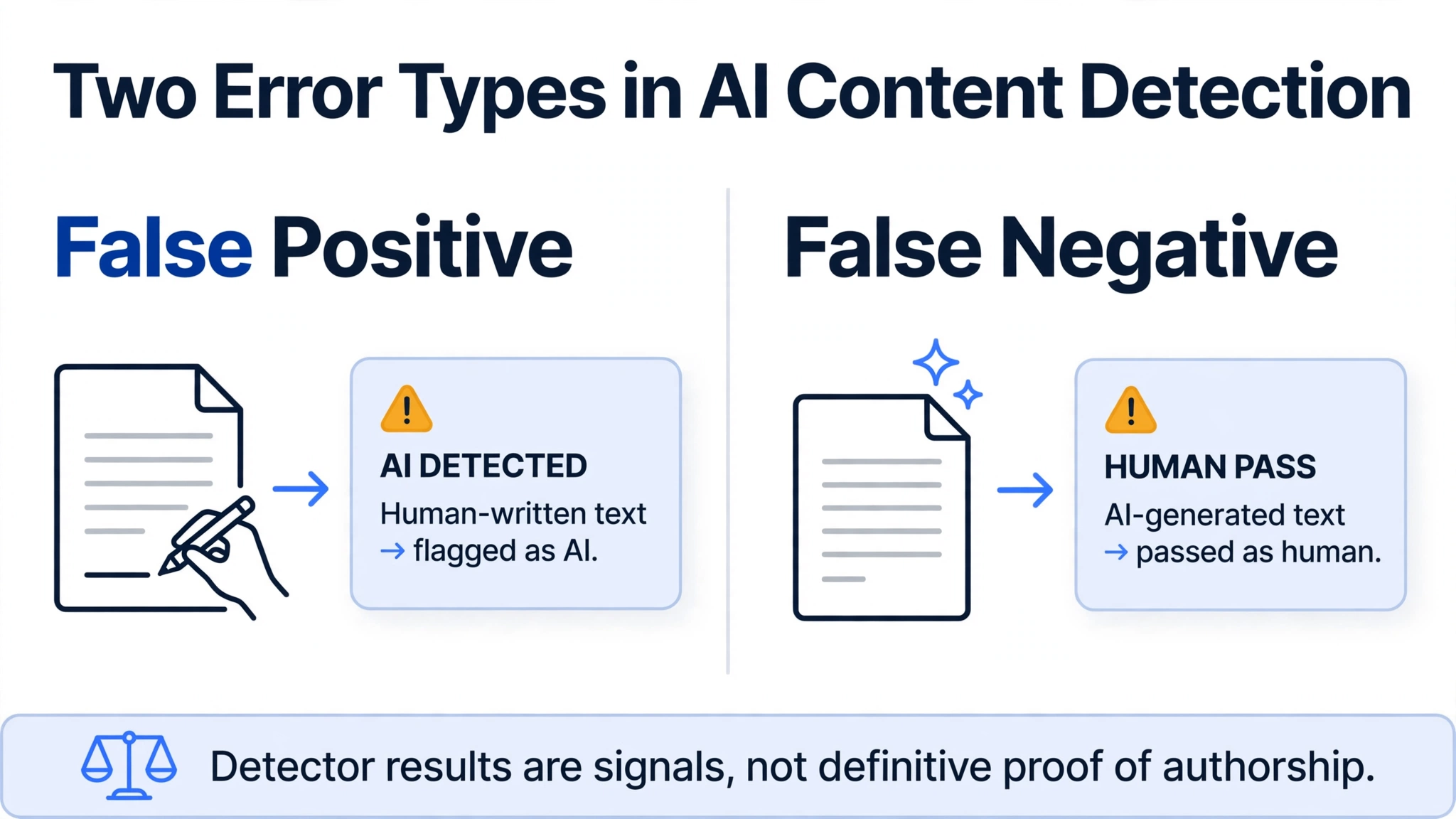
A false positive happens when a detector labels human-written text as AI-generated.
This can happen because human and AI writing share statistical patterns. Highly formal writing, repetitive structures, short samples, unusual phrasing, and some edited or translated text can make classification more difficult.
Turnitin explicitly warns that its AI model may misidentify human-written content, and its guidance says results should be interpreted carefully rather than used as the sole basis for adverse action. (Turnitin)
Research has also raised concerns about uneven detector performance across different writing styles and languages. That is one reason false positives should be treated as a central evaluation criterion, not a footnote.
How to Choose the Right AI Detector
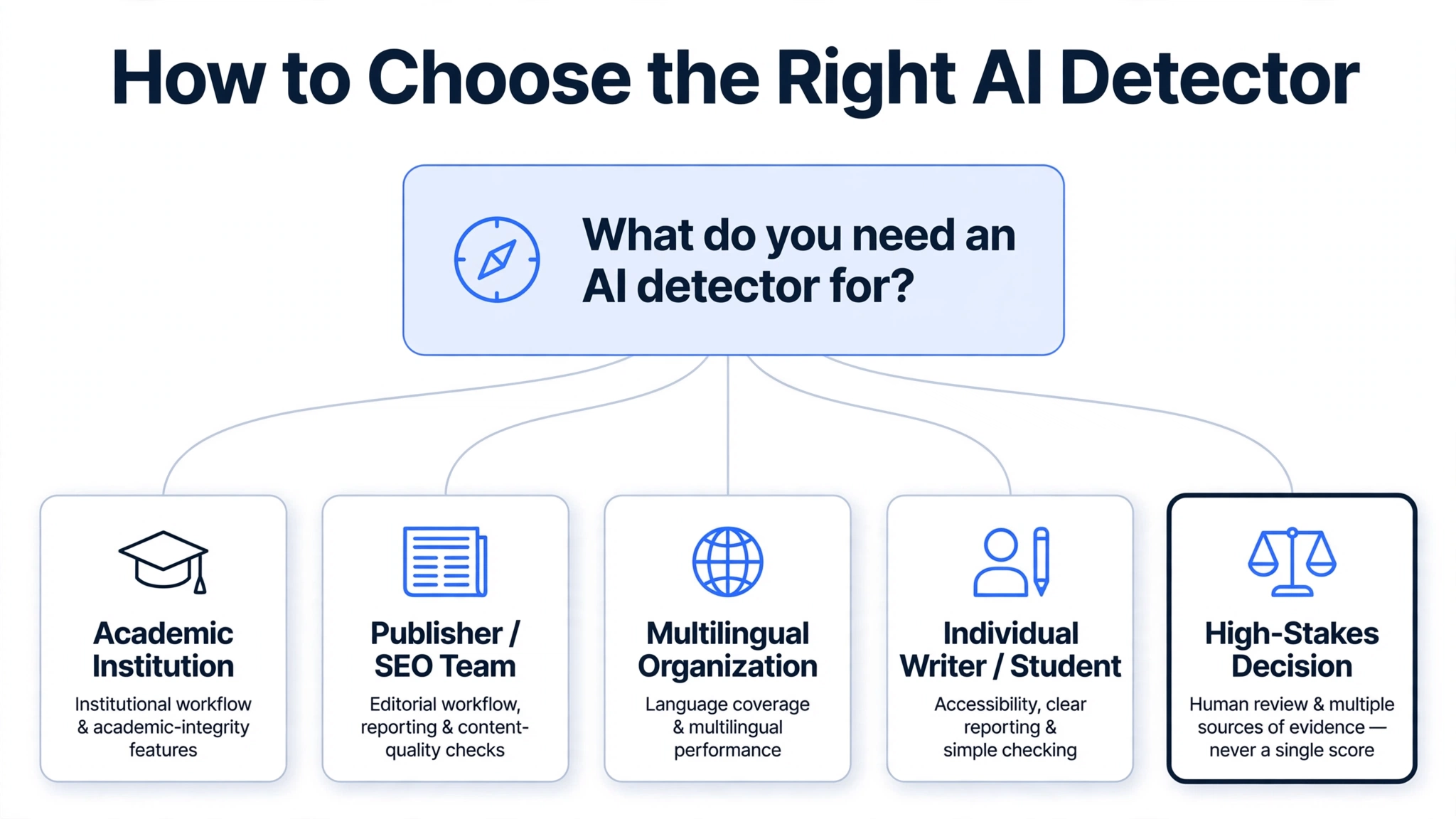
For universities or institutional academic workflows: start with Turnitin or another system already approved by the institution.
For publishers and SEO content teams: look closely at Originality.ai, Pangram, GPTZero, or Copyleaks based on your workflow and testing needs.
For multilingual organizations: prioritize language coverage, then verify how the detector performs in the languages you actually publish.
For individuals and students: accessibility and clear reporting may matter more than a vendor's headline accuracy percentage.
For high-stakes decisions: never rely on one detector alone. Combine the result with human review and other evidence.
OpenWriterAI AI Detector: Where It Fits
OpenWriterAI also provides an AI content detector for users who want to check text as part of their writing workflow. Its current detector page presents AI-content checking with sentence-level analysis. OpenWriterAI AI detector
For a writer creating articles, resumes, proposals, or other content, the practical approach is to use detection as a review step rather than trying to “pass” a detector. Quality, originality, factual accuracy, and clarity should come first.
That approach is especially useful when you are checking your own draft and want to investigate why certain passages may look machine-generated.
Frequently Asked Questions
What is the best AI detector in 2026?
There is no universally best AI detector. The right choice depends on your use case, acceptable false-positive risk, language, workflow, integrations, and how much evidence you need to interpret a result.
Are AI detectors accurate?
They can identify statistical patterns associated with AI-generated writing, but they can also produce false positives and false negatives. Accuracy varies with the model, dataset, writing style, text length, and other testing conditions.
Can an AI detector be wrong?
Yes. A human-written document can be flagged as AI-generated, and AI-generated text can be classified as human-written. That is why detector results should be treated as signals rather than definitive proof.
What is the best free AI detector?
Several tools provide free or limited free access, including GPTZero, Scribbr, and other commercial detectors with limited checks. The “best” option depends on whether you value accessibility, language support, reporting, or a particular workflow.
What is the best AI detector for academic writing?
For institutions, Turnitin is especially relevant because its AI detection is integrated into an academic-integrity workflow. Individual students may also use accessible detectors for self-checking, but their results should not be treated as definitive proof.
Are AI detectors reliable for non-native English writing?
Reliability can vary by detector and dataset. Research has raised concerns about false positives and uneven performance across different writing styles and language backgrounds, so extra caution is appropriate.
Can AI detectors detect edited or paraphrased AI text?
Some detectors specifically attempt to identify AI-generated text that has been altered by paraphrasing or rewriting tools. However, performance can vary significantly after editing, so no detector should be assumed to catch every modified sample.
Should I use two AI detectors?
For a personal quality check, comparing two independent signals can help you investigate an unexpected result. It still does not turn detector output into proof of authorship.
Final Takeaway
The best AI detector is the one that fits the situation and gives you enough context to make a responsible decision.
For academic institutions, workflow integration may matter most. For publishers, multilingual teams, and content operations, reporting, integrations and editorial controls may matter more. For individuals, accessibility can be the deciding factor.
Most importantly, do not confuse a detector score with certainty. Use AI detection to identify text worth reviewing, then use human judgment and other evidence to understand what actually happened.
Found this helpful?